
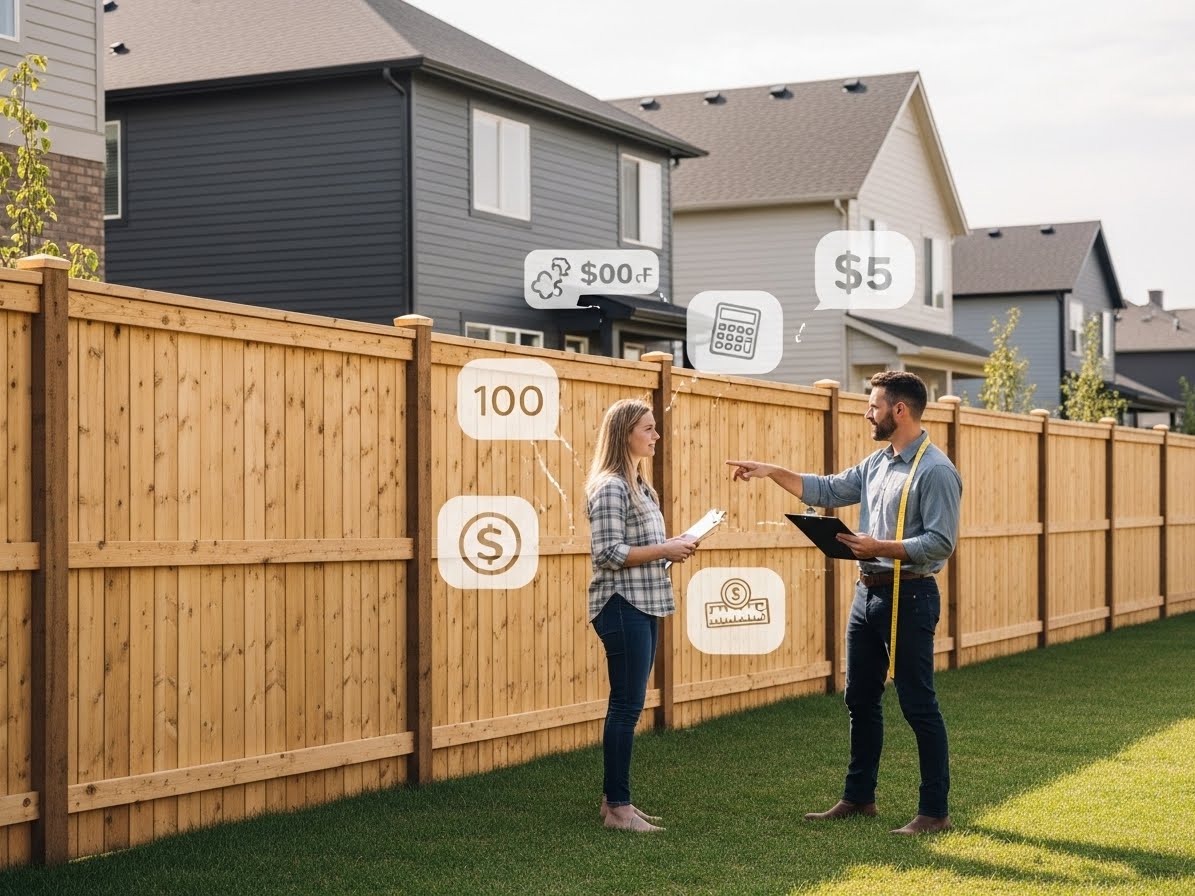
You’re probably looking at this project and wondering what it’ll really set you back. Let’s cut through the confusion and talk real numbers.
Building a fence isn’t like buying a couch, where you see one price tag. There’s the material you choose, the guys doing the work, how tall you want it, and a bunch of other stuff that can swing your total cost pretty dramatically. Some folks spend just over a thousand bucks for something basic, while others drop seven grand or more for premium setups.
Here’s the thing: knowing what affects your price helps you make smarter choices. You don’t want to get halfway through this project and realize you forgot to budget for something important. So let’s break down what you’re really paying for when you fence in 100 feet of your property.
Overview (Must-Read Summary)
A 100-foot fence can cost anywhere from $1,000 for basic materials to over $7,000 installed, with most common wood or vinyl privacy fences falling in the $1,500 to $6,000 range, depending heavily on material (wood, vinyl, chain link, etc.), height, labor rates, and features like gates.
Average Cost of a 100 Ft Fence
Most homeowners spend between $2,500 and $5,000 for a standard 100-foot fence installation. That’s the honest middle ground where you get decent quality without going overboard.
But your actual price? It depends on what you’re building and who’s building it.
The national average sits around $27 per linear foot when you include materials and labor. Multiply that by 100 feet, and you’re looking at roughly $2,700. Some people pay way less. Others pay significantly more. Geography matters too—what costs $3,000 in rural Tennessee might run $5,500 in suburban California.
Why such a huge range? Think about it like buying a car. You can get a reliable sedan or a luxury SUV. Both get you from point A to point B, but one costs a lot more. Same deal with fences.
Here’s how the price brackets typically shake out:
- Budget range: $1,000 – $2,500 – You’re looking at basic chain link or a simple wire fence, probably doing some of the work yourself, keeping it shorter (around 4 feet), and sticking with the most affordable materials.
- Mid-range: $2,500 – $5,000 – This is where most people land. You’re getting a decent wood privacy fence or a basic vinyl option, professional installation, standard height (6 feet), and maybe one gate.
- Premium installations: $5,000 – $7,000+ – Now we’re talking high-end vinyl, ornamental aluminum, wrought iron, or specialty wood like cedar. Add extra height, custom gates, decorative elements, or tricky terrain, and costs climb fast.
The wild variation comes down to three big things: what your fence is made of, how much work goes into putting it up, and any extras like gates or dealing with rocky soil.
Cost Breakdown by Material
Your material choice is probably the single biggest decision affecting your wallet. Let’s look at what each option actually costs.
Wood remains the go-to for most homeowners. It looks great, offers privacy, and won’t destroy your budget.
For 100 linear feet, expect to pay between $1,500 and $4,500 installed. That breaks down to about $15 to $45 per foot, depending on the type of wood and style you choose.Pressure-treated pine is your budget-friendly option, running maybe $15-25 per foot. Cedar costs more—usually $25-40 per foot—but lasts longer and resists rot better. Redwood sits at the top end, sometimes hitting $45 per foot or more, but it’s gorgeous and incredibly durable.Most wood fences need maintenance every few years. You’ll be staining or sealing it to keep it looking good and lasting longer. Factor the ongoing cost into your decision.
Vinyl costs more upfront, but here’s why people still choose it: you basically never have to maintain it.
You’re looking at $2,000 to $6,000 for 100 feet installed, or about $20 to $60 per linear foot. That’s noticeably more than basic wood.
But think long-term. No painting. No staining. No rotting. You hose it off when it gets dirty, and that’s about it. Over 20 years, you might actually save money compared to maintaining wood fences.
Vinyl holds up great in different climates too. Rain, snow, humidity—it doesn’t care. The color goes all the way through the material, so even if it gets scratched, you won’t see a different color underneath.
Need something affordable that gets the job done? Chain link is your answer. For 100 feet, you’ll spend roughly $1,000 to $2,500 installed. That’s only $10 to $25 per foot, making it the cheapest option that’s still actually durable.
It won’t give you privacy, and let’s be honest—it’s not winning any beauty contests. But it clearly marks your property line, keeps dogs in the yard, and lasts for decades with basically zero maintenance.
Some folks dress up chain link with slats woven through the links or let vines grow on it. Helps with the looks and adds some privacy.
Want something that looks fancy? These decorative metals make a statement.
Aluminum runs $2,500 to $5,000 for 100 feet, while genuine wrought iron can hit $10,000 or more. We’re talking $25 to $100+ per foot here.Aluminum won’t rust, which is great. It’s lighter and easier to work with than iron. You get that elegant look without the crazy maintenance.
Real wrought iron costs a fortune but lasts practically forever and looks incredible. Most “wrought iron” fences today are actually steel made to look like traditional ironwork. Still looks good, costs less, but you’ll need to watch for rust and repaint occasionally.
How Much Is 100 Linear Feet of Fencing?
Let’s clear up what “linear feet” actually means. It’s just the total length of your fence in a straight line. If you’re fencing 100 feet, you’re covering that distance regardless of whether it goes straight, turns corners, or zigzags across your yard.
When contractors quote prices “per linear foot,” they’re giving you the cost for each foot of fence. Simple multiplication gets you the total.
Here’s what you’ll pay per linear foot for different materials:
- Chain link: $10 – $25 per foot – Most affordable. A 100-foot fence costs $1,000 to $2,500 total.
- Wood: $15 – $45 per foot – The sweet spot for most homeowners. That’s $1,500 to $4,500 for 100 feet.
- Vinyl: $20 – $60 per foot – Higher initial investment. You’re spending $2,000 to $6,000 for your 100 feet.
- Aluminum/iron: $25 – $100+ per foot – Premium territory. Could be $2,500 to $10,000+ for 100 feet.
Let’s say you choose a standard 6-foot wood privacy fence at $28 per linear foot. That’s 100 feet × $28 = $2,800 total. But if you go with vinyl at $42 per foot, you’re at $4,200. Same length, way different price tag.
These numbers typically include both materials and professional installation. If you’re buying materials only for a DIY project, cut those costs roughly in half.
How Much Is 100 Linear Feet of Fencing?
Labor usually eats up 40-50% of your total fence cost. Yeah, it’s that significant.
Fence installers price their work in different ways. Some charge per foot of fence installed. Others bill by the hour. A few might give you one flat rate for the whole project.
Here’s what you’re likely to encounter:
- Per-foot labor: $8 – $30+ – This is common. A 6-foot privacy fence takes more work than a 4-foot picket fence, so taller or more complex fences cost more per foot.
- Hourly labor: $40 – $80 per hour – Some contractors prefer this, especially for tricky jobs where they can’t easily estimate time.
- Labor usually equals 40–50% of total cost – If your total bill is $4,000, expect roughly $1,600-$2,000 to be labor. The rest is materials.
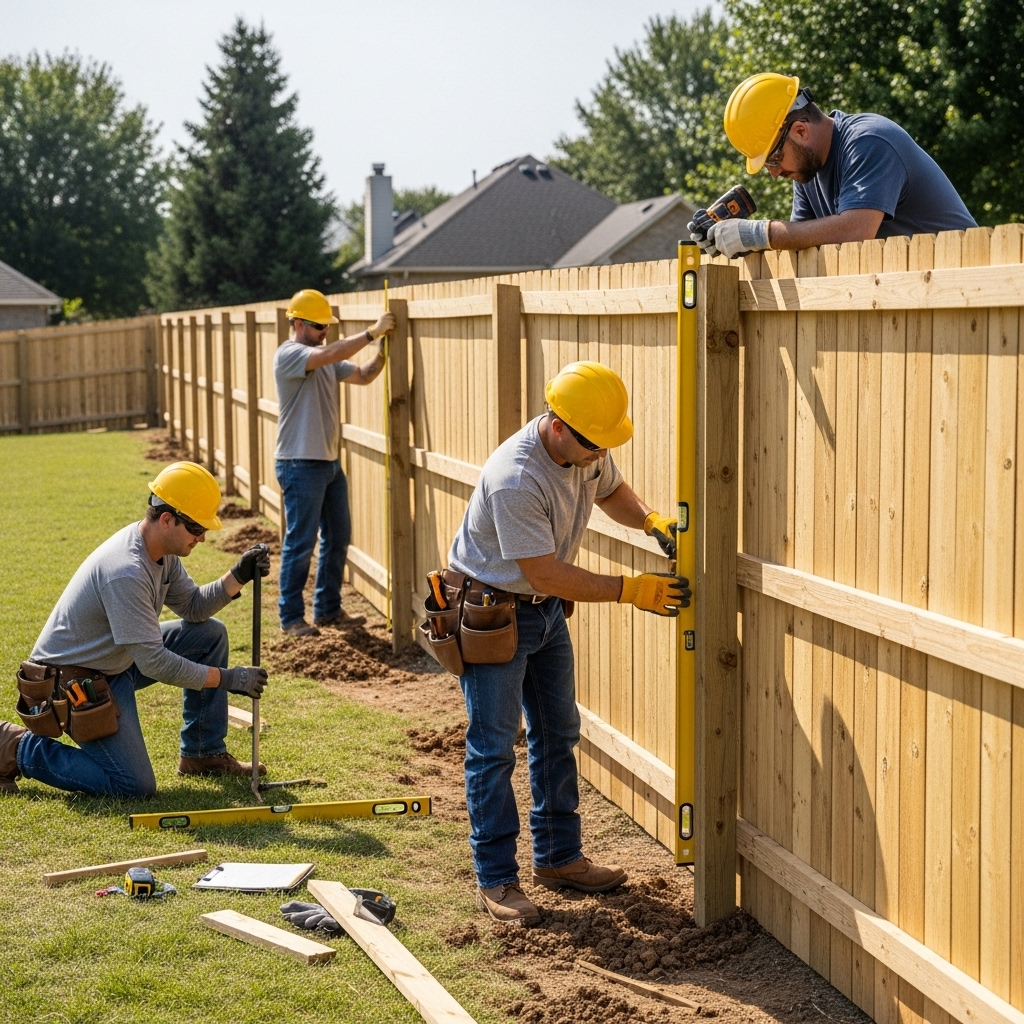
Installing a fence involves more than just banging boards together. The crew has to dig post holes (usually 2-3 feet deep), set posts in concrete, let that cure, level everything, attach rails and pickets or panels, hang gates, and make sure it all lines up perfectly.
Terrain matters big time for labor costs. Flat, easy-to-dig soil? Lower labor charges. Rocky ground or steep slopes? That’s harder work, which means higher bills.The number of gates affects labor too. Each gate needs extra hardware, careful alignment, and time to install properly. Gates are fiddly.
Key Factors That Affect Fence Pricing
Beyond the obvious material choice, several other things can push your cost up or down.
Fence height is huge. A 4-foot fence uses less material and takes less time to install than an 8-foot fence. Each additional foot of height adds roughly $2-8 per linear foot to your cost. Most privacy fences are 6 feet tall, but if you want 8 feet for extra privacy, budget accordingly.
Soil and terrain conditions can be budget killers. Normal dirt? No problem. But rocky soil means more work digging holes. Slopes require stepped or racked fence designs, which take extra time and materials. Tree roots in the way? That’s more labor to work around them.
The number of gates adds to the price. A basic gate kit runs $50-300 for materials, plus installation labor. Wider driveway gates or fancy automatic gates cost significantly more. Each gate adds $150-500 to your total project cost on average.
Permits and local regulations can’t be ignored. Many cities require permits for fences over a certain height. Permits typically cost $20-200, depending on location. Some neighborhoods have HOA rules about fence height, color, or style. Breaking these rules can mean tearing down your new fence and starting over.
Removal of old fencing runs about $3-8 per linear foot if you’re replacing an existing fence. For 100 feet, that’s another $300-800 on top of everything else. Some contractors include removal in their quote. Others charge extra. Always ask.
Is It Cheaper to Install Your Own Fence?
Short answer: Yes, DIY can save you serious money on labor. But it’s not always the smart move.
When you install a fence yourself, you’re basically cutting labor costs from your budget. That’s potentially $800-2,000 in savings for a 100-foot fence. Not bad, right?
But hold on. There are hidden costs people forget about.
DIY definitely saves on labor. No question. You’re not paying someone $20-40 per hour to do the work. If you’re handy and have time, this is the main appeal.
Hidden DIY costs pile up fast, though. You’ll need to rent or buy tools: post hole diggers (or a power auger), a level, a saw, a drill, measuring tape, and probably more. Tool rental alone can hit $100-300. If you mess up measurements or installation, you’re buying replacement materials out of pocket.
Your time has value, too. Installing 100 feet of fence takes a weekend at a minimum for experienced DIYers. Could be longer if you’re learning as you go. That’s time away from family, other projects, or relaxation.
When does DIY make sense? If you’re reasonably handy, have done similar projects before, have the tools already, and aren’t in a huge rush, go for it. Simpler fence styles like basic picket or short chain link are pretty DIY-friendly. The satisfaction of doing it yourself counts for something, too.
When should you hire professionals? Complex installations, tall privacy fences, difficult terrain, or situations where you need it done right and fast. Professionals have the experience to handle unexpected problems. They’ve got the right tools. They finish faster. And most offer warranties on their work.
Nobody wants to spend a weekend digging holes in August heat only to end up with a crooked fence.
Sample Cost Scenarios
Let’s look at three real-world examples so you can see how this plays out.
Budget chain link example: You need a 100-foot, 4-foot-tall chain link fence to keep your dog contained. You’re not worried about privacy or looks. Materials cost about $600-900. Labor adds another $400-800. Total project cost: $1,000-1,700. This is the bare minimum that still works.
Mid-range wood privacy fence: You want a standard 6-foot cedar privacy fence with one gate. Cedar materials run roughly $1,800-2,500. Professional installation costs $1,200-1,800. Add $200 for the gate. You’re looking at $3,200-4,500 total. This is what most homeowners actually build.
Premium vinyl fence with gate: You’re going all-in with high-quality vinyl, 6 feet tall, decorative post caps, and a matching gate. Materials cost $3,000-4,000. Installation runs $1,500-2,500. The gate adds $300-500. Your total: $4,800-7,000. But you’ll never paint or stain this fence, and it’ll look great for decades.
See how different goals lead to different prices? All three scenarios involve 100 feet of fence, but the costs vary wildly based on what you’re trying to achieve.
Common Mistakes That Increase Fence Cost
Let’s talk about the expensive screw-ups people make.
Incorrect measurements are probably the most common mistake. You measure wrong, order materials for 100 feet, but you actually need 120 feet. Now you’re making another trip to the store, paying more for materials, and dealing with delays. Always measure twice. Account for gates. Check your property line—you don’t want to build on your neighbor’s land.
Choosing the wrong materials for your situation costs money. Installing wood in an area with lots of ground moisture? It’ll rot faster. Putting up vinyl in an area with extreme temperature swings? Some vinyl can crack. Match your material to your climate and needs.
Skipping permits seems like a money-saver until code enforcement makes you tear down your fence. Then you’re paying for removal, permit fees, and rebuilding. Just get the permit upfront. It’s way cheaper than doing it twice.
Poor post-installation is the foundation mistake that ruins everything. If posts aren’t set deep enough (minimum 2 feet, preferably 3 feet in frost areas) or aren’t properly cemented, your fence will lean, sag, or fall over. Fixing this means tearing everything out and starting over. Do it right the first time.
Tips to Save Money on a 100 Ft Fence
Want to keep costs reasonable without cutting corners? Here’s how.
Choose the right material for your budget and needs. Don’t buy premium cedar if pressure-treated pine works fine for you. Don’t get vinyl if you actually like the look of wood and don’t mind maintenance. Match the material to what you actually need, not what sounds impressive.
Install during the off-season. Fence contractors are busiest in spring and summer. Fall and winter often bring lower prices because contractors want to keep their crews working. You might save 10-20% by scheduling your project in November instead of May. Just make sure the ground isn’t frozen if you’re in a cold climate.
Get multiple quotes. Always, always get at least three estimates from different contractors. Quotes can vary by thousands of dollars for the exact same project. Don’t automatically pick the cheapest—consider their reputation and reviews—but comparing prices gives you negotiating power and helps you spot outliers.
Avoid unnecessary upgrades. Those decorative post caps look nice, but add $5-15 per post. Scalloped tops on panels cost more than straight tops. Gate automation is cool but expensive. Decide what’s actually important to you versus what’s just nice to have. Sometimes, simple is better.
Buy materials yourself if you’re hiring labor-only contractors. You might save money purchasing from a big-box store with a contractor discount versus paying the markup your installer adds. Just make sure you buy the right stuff—mistakes here cost more than any savings.
Wrapping This Up
So what’s a 100-foot fence really going to cost you? For most homeowners choosing wood or vinyl privacy fences with professional installation, you’re looking at $1,500 to $6,000. That’s a big range, but now you know why.
Your material choice makes the biggest difference. Chain link keeps costs low. Wood offers the best balance of looks and affordability. Vinyl costs more initially but saves on maintenance. Metal options like aluminum and iron sit at the premium end.
Don’t forget labor—it’s nearly half your total cost. Factor in extras like gates, difficult terrain, and removing old fencing. These additions can push your budget higher than you expected.
The smartest move? Get quotes from several contractors in your area. Talk about exactly what you want. Ask about warranties. Check their references. And really think about whether you want to DIY it or let professionals handle the work.
Budget smartly by understanding what drives costs up or down. Sometimes paying a bit more upfront—like choosing vinyl over wood—saves money long-term. Other times, going basic is perfectly fine for what you need.
Your fence is an investment in your property. Take the time to plan it right, and you’ll be happy with the result for years to come.
FAQ Section
Professional crews typically finish a 100-foot fence in 1-3 days, depending on the material and terrain. Simple chain link on flat ground? Maybe one day. A tall privacy fence on rocky, sloped ground? Could take three days or more. DIY installation usually takes a weekend or longer if you’re working around your schedule.
Chain link wins the affordability contest at $10-25 per linear foot installed. For 100 feet, that’s potentially just $1,000-2,500. Wire fencing is even cheaper but less durable. If looks don’t matter and you just need a boundary marker or pet containment, chain link is your budget-friendly answer.
Absolutely. Taller fences require more materials and more labor. Each additional foot of height typically adds $2-8 per linear foot. A 6-foot fence costs noticeably more than a 4-foot fence. An 8-foot fence costs even more. If you don’t need the extra height for privacy or security, stick with standard 6-foot or shorter to save money.
That depends on your priorities. Vinyl costs about 30-50% more than wood upfront, but it requires virtually no maintenance. No painting, staining, or sealing—ever. It won’t rot, warp, or attract insects. Over 20 years, you might spend less on vinyl than wood when you factor in maintenance costs and time. If you value low-maintenance solutions and plan to stay in your home long-term, vinyl makes financial sense.
